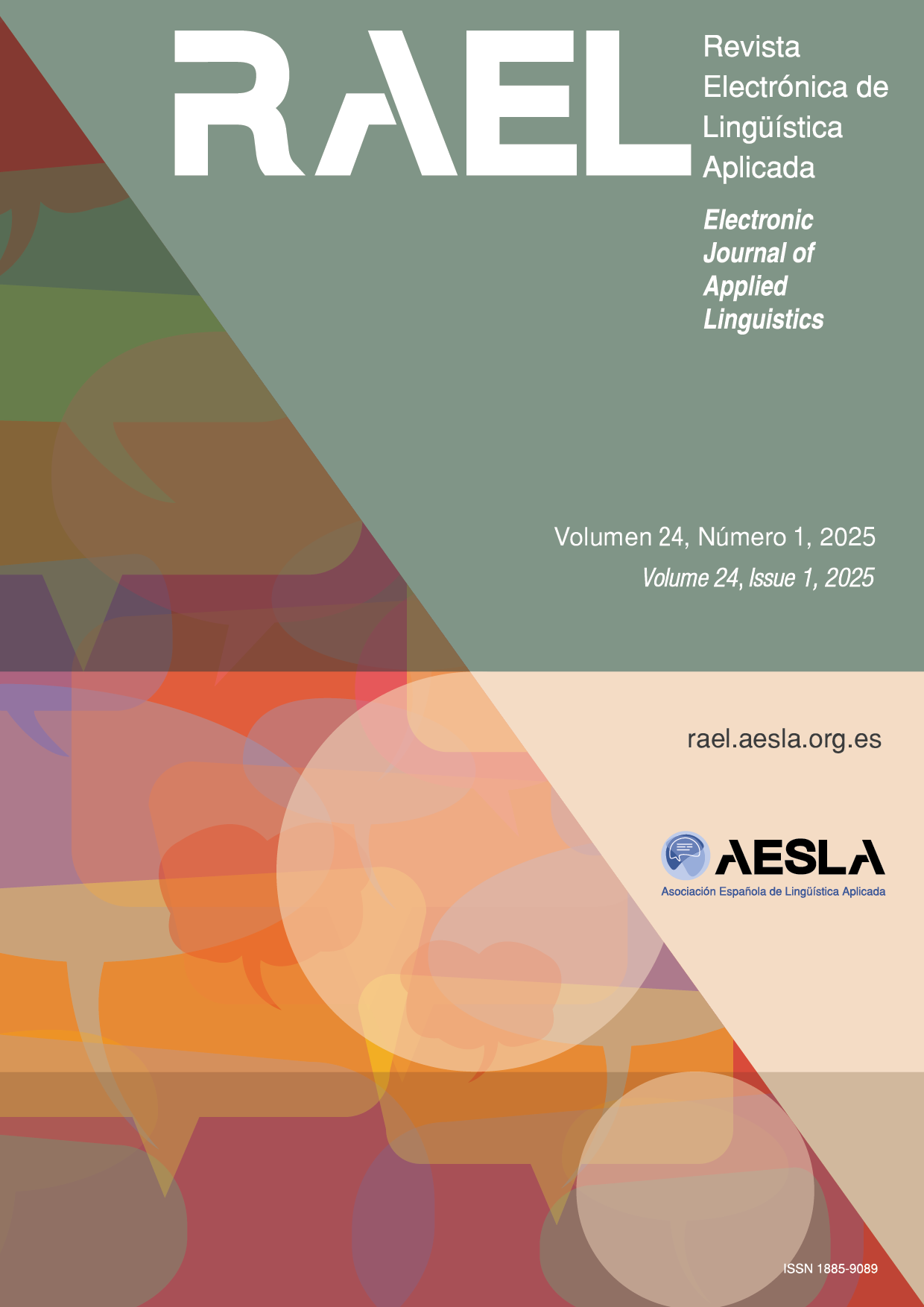
The Relationship between Language Learning Motivation, Language Level and Lexical Availability in Plurilingual CLIL
DOI:
https://doi.org/10.58859/rael.v24i1.657Keywords:
lexical availability, language level, motivation, plurilingual CLILAbstract
Language learning motivation, language level and lexical availability have all been suggested to be of key importance in a CLIL context. However, most research to date has focused solely on English, to the neglect of other foreign languages such as French. Given the calls for research into the benefits of CLIL in languages other than English, as well as alongside English, this study aims to determine whether there is a relationship between these three factors in Spanish learners who are simultaneously studying two foreign languages (English and French) in a plurilingual CLIL context. Results indicate clear differences between the relationships observed depending on the language at hand, with clearer correlations between the three in English as compared to French. The findings offer important implications for CLIL stakeholders in plurilingual contexts, particularly those which involve the teaching of other foreign languages in the shadow of global English.
Downloads
Global Statistics ℹ️
|
1935
Views
|
353
Downloads
|
|
2288
Total
|
|
References
Agustín Llach, M. P., & Fernández Fontecha, A. (2014). Lexical variation in learners’ responses to cue words: The effect of gender. In R. M. Jiménez Catalán (Ed.), Lexical availability in English and Spanish as a second language (pp. 69-81). Dordrecht: Springer. https://doi.org/10.1007/978-94-007-7158-1 DOI: https://doi.org/10.1007/978-94-007-7158-1_5
Alejo González, R., & Piquer Píriz, A. M. (2016). Measuring the productive vocabulary of secondary school CLIL students: Is Lex30 a valid test for low-level school learners? Vigo International Journal of Applied Linguistics, 13, 31-54.
Arribas, M. (2016). Analysing a whole CLIL school: Students’ attitudes, motivation, and receptive vocabulary outcomes. Latin American Journal of Content & Language Integrated Learning, 9(2), 267-292. 10.5294/laclil.2016.9.2.2 DOI: https://doi.org/10.5294/laclil.2016.9.2.2
Attard-Montalto, S., & Walter, L. (2021). The CLIL4U Guidebook v.2 2021 with Technology Enhanced Learning. Retrieved from https://languages.dk/archive/clil4u/book/FINAL%20-%20THE%20UPDATED%20CLILSTORE%20GUIDEBOOK%20-%20DECEMBER%202021.pdf
Canga Alonso, A. (2017). Spanish L1 speakers’ and EFL learners’ available lexicon. Anuario de estudios filológicos, 40, 5-23. DOI: https://doi.org/10.17398/2660-7301.40.5
Cenoz, J., Genesee, F., & Gorter, D. (2014). Critical analysis of CLIL: Taking stock and looking forward. Applied Linguistics, 35(3), 243-262. https://doi.org/10.1093/applin/amt011 DOI: https://doi.org/10.1093/applin/amt011
Daller, H., & Phelan, D. (2006). The C-test and TOEIC® as measures of students’ progress in intensive short courses in EFL. In R. Grotjahn (Ed.), Der C-Test: Theorie, Empirie, Anwendungen/The C-Test: Theory, empirical research, applications (pp. 101-119). Frankfurt am Main: Peter Lang. https://uwe-repository.worktribe.com/output/1043394
Daller, H., van Hout, R., & Daller-Treffers, J. (2003). Lexical richness in the spontaneous speech of bilinguals. Applied Linguistics, 24, 197-222. https://doi.org/10.1093/applin/24.2.197 DOI: https://doi.org/10.1093/applin/24.2.197
Dalton-Puffer, C., Nikula, T., & Smit, U. (2010). Language use and language learning in CLIL classrooms: Current findings and contentious issues. Amsterdam: John Benjamins. https://doi.org/10.1075/aals.7 DOI: https://doi.org/10.1075/aals.7
de la Maya Retamar, M. (2016). El desarrollo de la competencia léxica en la adquisición del francés como segunda lengua extranjera en la ESO. PhD Dissertation, Universidad de Exdremadura. Retrieved from https://dehesa.unex.es/server/api/core/bitstreams/eaa94fee-0025-494f-95e9-c7d609209f95/content
de Smet, A., Mettewie, L., Galand, B., Hiligsmann, P., & van Mensel, L. (2018). Classroom anxiety and enjoyment in CLIL and non-CLIL: Does the target language matter? Studies in Second Language Learning and Teaching, 8, 47-72. 10.14746/ssllt.2018.8.1.3 DOI: https://doi.org/10.14746/ssllt.2018.8.1.3
de Smet, A., Mettewie, L., Hiligsmann, P., Galand, B., & van Mensel, L. (2019). Does CLIL shape language attitudes and motivation? Interactions with target languages and instruction levels. International Journal of Bilingual Education and Bilingualism, 26(5), 534-553. https://doi.org/10.1080/13670050.2019.1671308 DOI: https://doi.org/10.1080/13670050.2019.1671308
Dörnyei, Z. (2001). New themes and approaches in second language motivation research. Annual Review of Applied Linguistics, 21(1), 43-61. https://doi.org/10.1017/S0267190501000034 DOI: https://doi.org/10.1017/S0267190501000034
Dörnyei, Z., & Al‐Hoorie, A. H. (2017). The motivational foundation of learning languages other than Global English: Theoretical issues and research directions. The Modern Language Journal, 101(3), 455-468. https://doi.org/10.1111/modl.12408 DOI: https://doi.org/10.1111/modl.12408
Dörnyei, Z., & Csizér, K. (2012). How to Design and Analyze Surveys in Second Language Acquisition. In A. Mackey & S. M. Gass (Eds.), Research Methods in Second Language Acquisition: A Practical Guide (pp. 74-94). Oxford: Wiley-Blackwell. DOI: https://doi.org/10.1002/9781444347340.ch5
Dörnyei, Z., & Ushioda, E. (2013). Teaching and researching: Motivation (2nd ed.). London: Routledge. https://doi.org/10.4324/9781315833750 DOI: https://doi.org/10.4324/9781315833750
Fernández Fontecha, A. (2010). Gender and motivation in EFL vocabulary production. In R. M. Jiménez Catalán (Ed.), Gender Perspectives on Vocabulary in Foreign and Second languages (pp. 93-117). New York: Palgrave Macmillan. https://doi.org/10.1057/9780230274938_5 DOI: https://doi.org/10.1057/9780230274938_5
Fernández Fontecha, A. (2015). Motivation and vocabulary breadth in CLIL and EFL contexts. Different age, same time of exposure. Complutense Journal of English Studies, 23, 79-96. 10.5209/rev_CJES.2015.v23.51214 DOI: https://doi.org/10.5209/rev_CJES.2015.v23.51214
Fryer, L. K., Larson-Hall, J., & Stewart, J. (2018). Quantitative methodology. In A. Phakiti, P. de Costa, L. Plonsky, & S. Starfield (Eds.), The Palgrave handbook of applied linguistics research methodology (pp. 55-77). London: Palgrave Macmillan. DOI: https://doi.org/10.1057/978-1-137-59900-1_3
Geoghegan, L. (2023). The effect of CLIL on productive thematic vocabulary. International Journal of Applied Linguistics, 1-15. https://doi.org/10.1111/ijal.12506 DOI: https://doi.org/10.1111/ijal.12506
Geoghegan, L. (2024). Language Learning Motivation in Multilingual CLIL. Porta Linguarum: Revista Internacional de Didáctica de las Lenguas Extranjeras, 41, 137-151. https://doi.org/10.30827/portalin.vi41.26620 DOI: https://doi.org/10.30827/portalin.vi41.26620
Goris, J. A., Denessen, E. J. P. G., & Verhoeven, L. T. W. (2019). Effects of content and language integrated learning in Europe A systematic review of longitudinal experimental studies. European Educational Research Journal, 18(6), 675-698. https://doi.org/10.1177/1474904119872426 DOI: https://doi.org/10.1177/1474904119872426
Grujić, T., & Danilović, J. (2024). The validation of C-Tests in English language testing and Teaching. International Journal of Language Teaching, 14(2), 151-161 10.22034/ijlt.2024.446036.1329
Heras, A., & Lasagabaster, D. (2015). The impact of CLIL on affective factors and vocabulary learning. Language Teaching Research, 19(1), 70-88. https://doi.org/10.1177/1362168814541736 DOI: https://doi.org/10.1177/1362168814541736
Lasagabaster, D. (2011). English achievement and student motivation in CLIL and EFL settings. Innovation in language Learning and Teaching, 5(1), 3-18. https://doi.org/10.1080/17501229.2010.519030 DOI: https://doi.org/10.1080/17501229.2010.519030
Lasagabaster, D., & López Beloqui, R. (2015). The impact of type of approach (CLIL versus EFL) and methodology (book-based versus project work) on motivation. Porta Linguarum: Revista Internacional de Didáctica de las Lenguas Extranjeras, 23, 41-57. 10.30827/Digibug.53737 DOI: https://doi.org/10.30827/Digibug.53737
McManus, K. (2011). The development of aspect in a second language. PhD dissertation, Newcastle University, United Kingdom. Retrieved from http://hdl.handle.net/10443/1292.
Merino, J., & Lasagabaster, D. (2018). CLIL as a way to multilingualism. International Journal of Bilingual Education and Bilingualism, 21(1), 79-92. 10.1080/13670050.2015.1128386 DOI: https://doi.org/10.1080/13670050.2015.1128386
Milton, J. (2013). Measuring the contribution of vocabulary knowledge to proficiency in the four skills. In C. Bardel, C. Lindqvist, & B. Laufer (Eds.), L2 vocabulary acquisition, knowledge and use (pp. 57-78). Berlin: Language Science Press.
Navarro Pablo, M. & García Jiménez, E. (2018). Are CLIL students more motivated an analysis of affective factors and their relation to language attainment. Porta Linguarum: Revista Internacional de Didáctica de las Lenguas Extranjeras, 29, 71-90. 10.30827/Digibug.54023 DOI: https://doi.org/10.30827/Digibug.54023
Neilson Parada, M. (2016). Lexical Availability in Diaspora Spanish: A Cross-generational Analysis of Chilean Swedes. PhD dissertation, University of Illinois at Chicago, USA. Retrieved from https://indigo.uic.edu/articles/thesis/Lexical_Availability_in_Diaspora_Spanish_A_Cross-generational_Analysis_of_Chilean_Swedes/10834349/1/files/19342127.pdf
Ruiz de Zarobe, Y. (2011). Which language competencies benefit from CLIL? An insight into applied linguistics research. In Y. Ruiz de Zarobe, J. M. Sierra & F. Gallardo del Puerto (Eds.), Content and Foreign Language Integrated Learning: Contributions to Multilingualism in European Contexts (pp. 129-154). Bern: Peter Lang. https://doi.org/10.3726/978-3-0351-0171-3 DOI: https://doi.org/10.3726/978-3-0351-0171-3
Ryan, S. (2008). The Ideal L2 Selves of Japanese Learners of English. PhD dissertation, University of Nottingham, United Kingdom. Retrieved from https://eprints.nottingham.ac.uk/10550/
Sandu, B. M., & Oxbrow, G. L. (2021). Exploring the L2 motivational self system through lexical availability and overseas experience amongst English-major students in Gran Canaria. RAEL. Revista Electrónica de Lingüística Aplicada. 19(2), 108-125. 10.1017/S0261444820000154
Šifrar Kalan, M. (2014). Slovene students’ lexical availability in English and Spanish. In R. M. Jiménez Catalán (Ed.), Lexical Availability in English and Spanish as a Second Language (pp. 125-138). Dordrecht: Springer. https://doi.org/10.1007/978-94-007-7158-1 DOI: https://doi.org/10.1007/978-94-007-7158-1_8
Downloads
Published
How to Cite
Issue
Section
License
Copyright (c) 2025 Leah Geoghegan

This work is licensed under a Creative Commons Attribution-NonCommercial 4.0 International License.
Attribution - Non-commercial (CC BY-NC). Under this license the user can copy, distribute and publicly display the work and can create derivative works as long as these new creations acknowledge the authorship of the original work and are not used commercially.
Authors retain the copyright and full publishing rights without restrictions.